

If you’ve ever heard someone say they “made money on a stock,” they’re usually talking about capital gains.
But what are capital gains, really?
Let’s break it down in the simplest way possible. No confusing language. No complicated formulas. Just a clear explanation of how value can grow when you own something over time.
What Are Capital Gains? A Simple Definition
Capital gains are the increase in value of something you own over time.
That’s the core idea.
If you buy something at one price and later it is worth more, that increase in value is your capital gain.
For example:
- You buy something for $50
- Later, it is worth $80
- Your capital gain is $30
In other words, capital gains are simply about growth in value.
An Easy Real-World Example
Imagine you buy a vintage baseball card for $20.
A few years later, more collectors want it, and now it is worth $75.
- You paid $20
- It is now worth $75
- Your capital gain is $55
Nothing magical happened. The item simply became more valuable over time.
Stocks work in a similar way.
When you own a share of a company, and that company becomes more valuable over time, your share may increase in value, too. That increase is what people mean when they talk about capital gains explained in plain English.
For more background on how share ownership works, visit Detailed Stock Information.
Capital Gains and Stocks: How It Works
When you buy a stock, you are buying a small piece of ownership in a company.
If that company grows, becomes more popular, earns more business, or attracts more demand, the value of that ownership can rise. When it does, you may have a capital gain.
This is one reason stock ownership can be such a powerful learning tool. It helps people see that ownership is not just about having something today. It is also about watching how that value can change over time.
That is especially helpful for beginners who are trying to understand stock profit basics without getting lost in technical language.
The Difference Between What You Paid and What It’s Worth
One of the easiest ways to understand capital gains for beginners is to focus on two numbers:
- What you paid for something
- What it is worth now
The difference between those two numbers is where a gain or loss comes from.
If the current value is higher than your original price, that is a gain.
If the current value is lower, that is a loss.
The important point is that value can change over time. You do not need to constantly buy and sell things to understand this idea. Sometimes simply owning something and holding onto it is enough to see how value works.
Why Can Value Change Over Time?
Many beginners wonder why a stock’s value does not stay the same forever.
Here is the simple answer: value changes because businesses, brands, and demand change.
1. Company Growth
If a company expands, reaches more customers, or improves its business, people may see it as more valuable.
2. Brand Strength
Well-known companies often have strong customer loyalty and broad recognition. That can influence how people view the company’s value over time.
3. Demand
If more people want to own shares of a company, that can affect the share’s value.
4. Time
Growth often does not happen overnight. It can take years for value to build.
This is why understanding stock value growth is closely tied to patience. Sometimes the biggest lesson is simply learning that value can grow slowly and steadily.
Why Long-Term Ownership Matters
Capital gains make more sense when you think about ownership over the long term.
Short-term price changes can happen all the time. But for beginners, the more useful lesson is often this: ownership gives value time to grow.
Long-term ownership matters because it allows:
- companies time to grow,
- brands time to strengthen, and
- owners time to learn how value changes over the years.
That is a healthier and more meaningful mindset than focusing only on quick price moves.
At GiveAshare, the ownership experience matters. A share is not just a number on a screen. It can be a tangible reminder that the owner holds a real piece of a company and can watch that story unfold over time.
Learn more about meaningful ownership gifts through our One Share with Stock Certificate products.
Capital Gains Are About Ownership, Not Just Selling
People sometimes hear “capital gains” and immediately think about buying and selling fast.
But that is not the most helpful way for beginners to understand the idea.
A better way to think about capital gains is this: they are one possible result of owning something that grows in value.
That shift matters.
Instead of focusing on constant trading, it encourages an ownership mindset:
- You own a real asset
- You stay connected to its story
- You learn how value changes with time
- You build financial literacy through experience
For children, teens, and first-time owners especially, that can be a powerful introduction to how the world of stocks works in real life.
Why This Matters for Financial Literacy
Learning what capital gains are is not about becoming a day trader. It is about understanding one of the most basic ideas in ownership: sometimes things you own can become more valuable over time.
That lesson supports broader financial literacy because it teaches people to think about:
- ownership,
- patience,
- value, and
- long-term thinking.
These are simple but important concepts, especially for beginners who want a less intimidating way to learn.
If you are new to stock gifting or want answers to common questions, visit the FAQs.
Quick Takeaways
- Capital gains means an increase in value over time.
- It happens when something you own becomes worth more than what you paid for it.
- Stocks can rise or fall in value as companies grow and demand changes.
- Long-term ownership helps people better understand how value growth works.
- The real lesson is not just profit. It is learning the value of ownership.
Frequently Asked Questions
What are capital gains in simple terms?
Capital gains are the increase in value of something you own. If you buy something at one price and later it is worth more, the difference is your capital gain.
Are capital gains only about stocks?
No. Capital gains can apply to many things, including stocks, collectibles, real estate, and other assets that may rise in value over time.
Do I have to sell to benefit from a capital gain?
People usually talk about a gain being completed when something is sold, but even before that, you can still understand that the value of what you own has increased.
Why do stocks change in value?
Stocks can change in value because companies change. Growth, demand, brand strength, and time can all affect how much a share is worth.
Why is long-term ownership important?
Long-term ownership helps people focus on the bigger picture. Instead of watching every short-term move, they can learn how value may develop gradually over time.
The Bigger Idea: Ownership That Can Grow
Capital gains are just one part of a bigger lesson: ownership matters.
When someone owns a share of stock, they are connected to something real. They can follow the company, learn how value changes, and build a stronger understanding of long-term thinking.
That is why stock ownership can be such a meaningful gift. It combines a keepsake, a learning experience, and an introduction to real-world financial literacy.
A Meaningful Gift That Lasts
Instead of giving something forgettable, give something with meaning behind it.
A stock gift can represent:
- a real ownership experience,
- a lasting keepsake,
- a conversation about value and growth, and
- a memorable introduction to financial literacy.
If you want to create a tangible ownership moment, explore our One Share with Stock Certificate products and help someone start an ownership story they can remember for years.

Featured Stocks
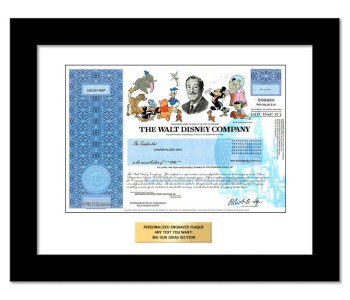
Disney Stock - One Share
$172.00 $182.00
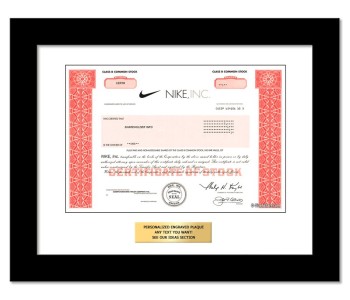
Nike Stock - One Share
$86.00
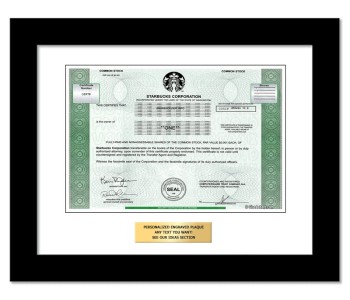
Starbucks Stock - One Share
$147.00


Write a comment