
If you have ever wondered what it actually means to own stock, you are not alone. Financial terms can sound intimidating, and many beginner guides assume readers already understand concepts such as dividends, shareholders, voting rights, and annual reports.
The truth is much simpler.
Stock ownership is not just about numbers moving on a screen. At its core, owning stock means owning a small piece of a real company. Whether it is a company you shop with every week, a favorite entertainment brand, or a business that has been part of your family’s life for generations, becoming a shareholder means participating in that company’s story.
For many people, purchasing or receiving a single share is their first introduction to ownership, financial literacy, and long-term thinking.
This guide explains stock ownership for beginners in plain English. Along the way, you will learn what a stock is, what shareholders do, how dividends work, why companies publish annual reports, what voting rights mean, and how gifting stock can turn these concepts into a memorable ownership experience.
What Is a Stock?
A stock represents ownership in a company.
Imagine a company as a very large pie. Instead of one person owning the entire pie, the company is divided into millions, or sometimes billions, of small pieces. Each piece is called a share.
When you own one share, you own one small portion of that company.
Your ownership percentage may be tiny, but the basic idea is real: you are now a shareholder. Depending on the company and the type of shares involved, that ownership may come with certain rights and benefits.
Owning a share may allow you to:
- Become a recognized shareholder of the company
- Receive shareholder communications
- Review annual reports and company updates
- Vote on certain company matters
- Receive dividends if the company declares them
- Transfer or gift the share to another person
This is why stock ownership is often described as becoming a part owner of a business. You are not responsible for running the company, supervising employees, or making everyday decisions. You simply own a small portion of the business through your share.
For beginners, understanding this one concept makes nearly everything else easier: a stock is a unit of ownership in a company.
To learn more about how certificates have historically represented company ownership, visit GiveAshare’s guide to stock certificates and how they work.
How Stock Ownership Works
Public companies make shares available for people and institutions to buy and sell. When someone acquires a share, that person becomes one of the company’s shareholders.
The company continues operating its business. It may manufacture products, develop software, open stores, serve customers, hire employees, or expand into new markets. Shareholders are connected to the company through ownership, but they do not usually participate in routine business operations.
In simple terms, the relationship works like this:
- A company has ownership divided into shares.
- A person acquires one or more of those shares.
- That person becomes a shareholder.
- The shareholder keeps the ownership until the shares are sold or transferred.
The value of a share can change over time, but price movement is only one part of the ownership experience. A beginner can also learn by following the company, reading its communications, participating in eligible shareholder votes, and observing how a large organization operates.
GiveAshare provides detailed stock information to help gift buyers and recipients better understand the companies connected to available stock gifts.
Why Do Companies Sell Stock?
Companies often need money to grow. They may want to build facilities, develop new products, hire more employees, purchase equipment, enter new markets, or fund other major business activities.
One way a company can raise money is by selling ownership shares.
Instead of relying only on loans, the company can make shares available to investors. In exchange for the money raised, shareholders receive an ownership interest in the company.
This creates a basic relationship:
- The company receives capital that can support its business goals.
- The shareholder receives ownership represented by shares.
Public stock ownership allows many different people to own small portions of the same business. Large financial institutions may own millions of shares, while a first-time shareholder may begin with just one.
For educational purposes, one share can be enough to make the idea of company ownership feel real.
Dividends Explained in Simple Terms
A dividend is a payment that a company may choose to make to eligible shareholders.
One simple way to understand a dividend is to think of it as a company sharing a portion of its available profits with its owners.
However, not every company pays dividends. Some companies prefer to use their money to hire employees, build products, expand the business, pay down debt, or support other company priorities.
Companies that do pay dividends generally announce:
- The amount of the dividend
- The date used to determine eligible shareholders
- The date the payment is expected to be made
Dividends can change, be reduced, or be discontinued. They are not guaranteed simply because a company has paid them before.
Some companies also offer dividend reinvestment plans, commonly called DRIPs. These programs may allow eligible shareholders to use dividends to acquire additional shares or partial shares, depending on the plan’s rules.
GiveAshare maintains a helpful collection of stocks associated with dividend reinvestment plans for people who want to learn more about this ownership feature.
Annual Reports Explained
Most public companies publish an annual report that reviews the company’s business and financial activity over the previous year.
Think of an annual report as a detailed company report card. It helps shareholders understand what happened during the year, what leadership considers important, and what risks or priorities may affect the business.
An annual report may include:
- A letter from the chief executive officer
- A description of the company’s products or services
- Major accomplishments and business updates
- Financial statements
- Information about company leadership
- Discussion of challenges and business risks
- Plans or priorities for the future
Annual reports can be long and beginners do not need to understand every page. Starting with the shareholder letter or company overview can provide a simple introduction.
Reading these reports can help new shareholders see that stock ownership is connected to a real operating business. Behind every share are employees, products, customers, goals, decisions, and challenges.
Parents and teachers can also use annual reports as financial literacy tools. A young shareholder might look for recognizable products, compare company priorities from one year to the next, or discuss how a business serves its customers.
Voting Rights Explained
Some shares include the right to vote on certain company matters.
Shareholders do not vote on everyday decisions such as product prices, hiring choices, store hours, or advertising campaigns. Those responsibilities belong to the company’s management team.
Instead, eligible shareholders may be asked to vote on matters such as:
- Electing members of the board of directors
- Approving certain executive compensation proposals
- Reviewing corporate governance matters
- Considering shareholder proposals
- Approving major corporate actions when required
Voting materials are often delivered through a process known as proxy voting. Shareholders may be able to submit their votes online, by mail, by phone, or during a shareholder meeting.
The number of votes usually depends on the number and type of shares owned. A person with one voting share may have one vote, while an institution with millions of shares may have much greater voting influence.
Even so, receiving voting materials can make ownership feel more tangible for a beginner. It demonstrates that a shareholder is not simply watching a price. The shareholder is connected to the company through a defined ownership relationship.
The Long-Term Ownership Mindset
One common misconception is that stock ownership is only about buying and selling quickly.
In reality, many shareholders view ownership over years or even decades. A long-term ownership mindset focuses less on daily price movement and more on understanding the company over time.
A long-term shareholder may choose to:
- Follow company news and major announcements
- Read annual reports
- Review shareholder communications
- Learn how the company earns revenue
- Observe how products and services change
- Participate in eligible shareholder votes
This perspective can be especially useful for financial literacy. It encourages patience, curiosity, and a deeper understanding of how businesses operate.
For families, a stock gift can create an ongoing conversation. A parent or grandparent might help a child review a company’s products, find its annual report, discuss a shareholder letter, or understand why a business made a major decision.
The goal does not have to be predicting what a stock will do next. The educational value comes from learning what ownership means and observing how a real company develops over time.
Why a Physical Stock Certificate Makes Ownership Feel Real
Today, most stock ownership records are maintained electronically. That system is practical, but it can make ownership feel invisible, especially to a first-time shareholder.
A framed stock certificate changes the experience.
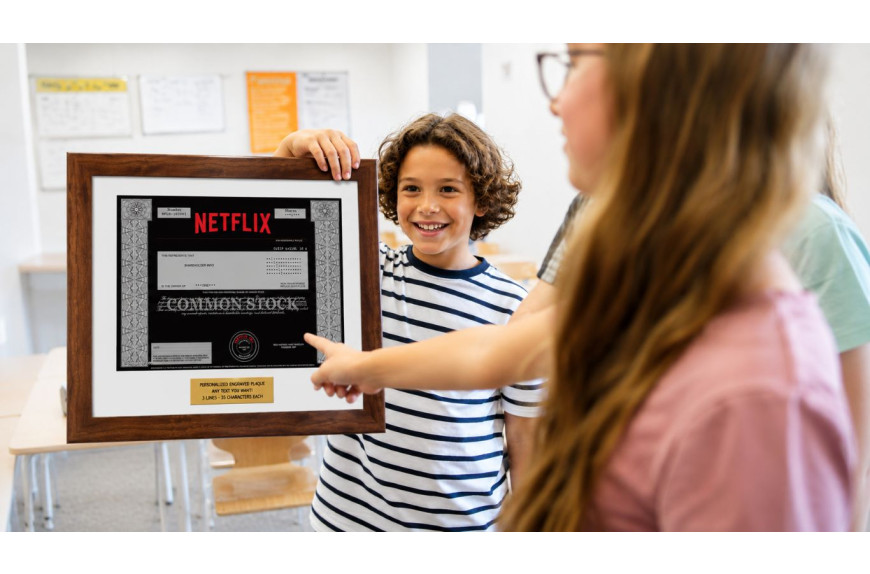
Instead of seeing only an account entry, the recipient receives a tangible display that celebrates becoming a shareholder. The certificate can be framed, displayed, and kept as a reminder of the occasion.
A framed certificate can represent:
- A first step into financial literacy
- A connection to a favorite company or brand
- A birthday or graduation milestone
- A family tradition
- A career achievement or retirement
- A keepsake that may be displayed for years
The certificate is not merely decoration. It gives the ownership story a visible form and creates a natural conversation starter.
GiveAshare makes it possible to give one share with a stock certificate so the recipient can celebrate ownership with a lasting keepsake.
How Gifting Stock Works
Gifting stock means purchasing a share for another person and completing the required process to register or transfer that ownership to the recipient.
Rather than receiving only a traditional present, the recipient becomes connected to a real company as a shareholder.
A stock gift can offer several experiences at once:
- A genuine ownership interest
- A memorable framed keepsake
- An introduction to shareholder basics
- A financial literacy conversation
- A meaningful connection to a familiar company
Stock gifts are often used to celebrate:
- Birthdays
- Graduations
- Weddings
- New babies
- Holidays
- Retirements
- Employee recognition
- Major personal milestones
The company selected for the gift can add personal meaning. A recipient might have a strong connection to a company’s products, work history, mission, entertainment, technology, restaurants, or cultural impact.
The result is a gift that combines celebration with education. It marks a special moment while introducing the recipient to what it means to own part of a business.
Teaching Kids About Stock Ownership
Stock ownership can be especially powerful as a teaching tool for children and teenagers.
Young people often recognize brands long before they understand how companies work. They know favorite stores, games, restaurants, movies, products, and technology. Receiving stock connected to a familiar company can turn that recognition into curiosity.
A child may begin asking questions such as:
- What does this company sell?
- How does the company make money?
- Who runs the business?
- Why do customers choose its products?
- What does being a shareholder mean?
- What information is included in an annual report?
These questions create opportunities to introduce important ideas without making the conversation overly technical.
Parents and grandparents can use a stock gift to discuss:
- Ownership
- Saving
- Business basics
- Patience
- Goal setting
- Financial responsibility
- Long-term thinking
GiveAshare’s guide to buying stocks for kids explains the process and provides additional information for families interested in creating an early ownership experience.
Common Beginner Misconceptions About Stock Ownership
“I have to buy hundreds of shares.”
You do not need to own a large number of shares to become a shareholder. A person can begin with one share.
“Owning one share does not count.”
One share still represents ownership. The percentage may be small, but the recipient can still experience many of the educational and symbolic aspects of being a shareholder.
“Only financial experts can understand stocks.”
Everyone starts as a beginner. The core ideas are straightforward once unfamiliar terminology is translated into plain language.
“Stock ownership is only about making money.”
Stock ownership can also be about education, connection, legacy, celebration, and understanding how businesses work. A stock gift may introduce a child to financial literacy, recognize an employee’s service, or commemorate a major life event.
“A stock certificate and a share are always the same thing.”
A share is the ownership interest. A stock certificate is a document associated with that ownership or, in some cases, a commemorative replica used for display. Because registration methods differ by company, it is important to understand exactly what is included with a stock gift.
GiveAshare’s frequently asked questions explain common details about ownership registration, certificates, delivery, and the gifting process.
Frequently Asked Questions About Stock Ownership
Is owning one share worth it?
One share can provide a real introduction to shareholder ownership. Its value as a gift may also come from the educational experience, personal connection, and framed keepsake that accompanies it.
Do all companies pay dividends?
No. Some companies pay dividends, while others use available funds for growth, operations, product development, acquisitions, debt reduction, or other business needs. Dividend payments are not guaranteed.
Can children own stock?
Children can own stock, although the ownership may need to be established through a custodial arrangement until the child reaches the age required under applicable law.
What happens after someone receives a stock gift?
The required registration or transfer process must be completed. Once ownership is properly established, the recipient is connected to the company as a shareholder and may receive eligible shareholder communications.
Are stock certificates still real?
Stock ownership records are commonly maintained electronically today. Depending on the company and gifting method, a recipient may receive a registered certificate, a statement of ownership, or a replica certificate designed as a commemorative display.
Does every shareholder get voting rights?
Not necessarily. Voting rights depend on the company and the class of stock owned. Some shares include voting rights, while others may have different terms.
What is the difference between a stock and a share?
“Stock” generally refers to ownership in a company, while a “share” is one individual unit of that ownership. In everyday conversation, the terms are often used interchangeably.
Where can beginners learn more?
Beginners can explore GiveAshare’s stock certificate education, review detailed information about available stocks, and visit the GiveAshare FAQ center for answers about stock gifts and ownership.
Why Stock Ownership Is More Than Investing
When people hear the word “stock,” they often think first about the stock market. But ownership can represent something much broader than a changing market price.
Stock ownership can be about:
- Understanding how companies operate
- Learning the responsibilities of ownership
- Following a business over time
- Starting conversations about financial literacy
- Celebrating a meaningful life event
- Creating a connection between generations
- Giving a keepsake with a lasting story
For a child, one share can become a first lesson in business and ownership. For a graduate, it can symbolize entering a new stage of life. For a retiring employee, it can celebrate years connected to a company or industry. For a family, it can become a tradition passed from one generation to the next.
The most memorable stock gifts are often tied to a personal story. The company might represent a favorite product, a family vacation, a first job, a career, a hobby, or a brand the recipient has loved for years.
That emotional connection is what can transform a single share into a genuine ownership moment.
Start an Ownership Journey with One Share
The best introductions to financial literacy often begin with one simple, memorable experience.
A single share can inspire curiosity, encourage learning, and create a lasting connection to the idea of ownership. It can help a child understand that companies have owners, give a graduate a meaningful symbol of the future, or recognize a milestone with something more lasting than an ordinary gift.
With GiveAshare, you can create that moment by giving one share with a framed stock certificate . The recipient receives more than a present. They receive a tangible introduction to shareholder ownership and a keepsake designed to preserve the story behind the gift.
Explore the available stock gift options, choose a company with personal meaning, and give someone the experience of becoming a shareholder.



Write a comment